Alex Morgan
A fictional creative director's complete portfolio, directed and built in one afternoon, with an MCP server as its only CMS.
- Client
- Self-initiated concept
- Role
- Creative direction, design & build
- Year
- Jun 2026
- Discipline
- AI-Assisted Development
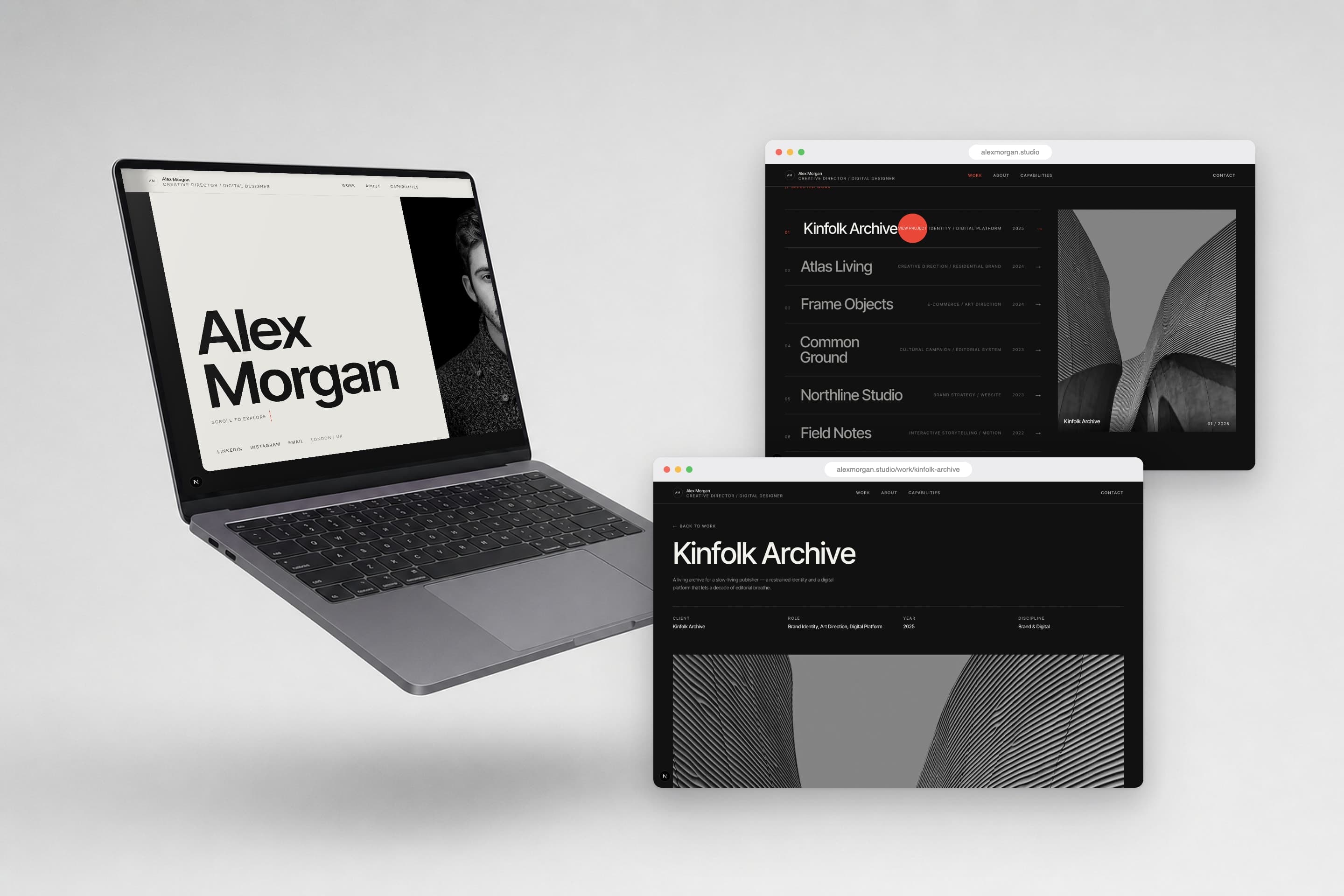
Alex Morgan is a creative director in London with six projects, a clear point of view and a contact page. None of it is real. I invented the persona and directed his complete portfolio into existence in one afternoon with Claude, to test two things at once: whether a full editorial identity can be art-directed end to end in a single working session, and whether a site can skip the admin panel entirely because its CMS is a conversation. Every frame below is the finished build running in a browser.
An identity of one accent
The system is dark editorial: a near-black page, warm off-white type, hairline rules for structure, and a single red-orange accent that does every job on the site, section labels, active states, the cursor, even text selection. One typeface, Inter Tight, runs the whole register from eleven-pixel spaced-out labels to a name set at a hundred and ninety pixels with the leading crushed to 0.86.
The photography is borrowed, credited stock, so the identity does the unifying work: every image is forced monochrome through one shared filter, which makes six unrelated sources read as a single commissioned shoot. On top sit the recurring motifs, slash-prefixed labels, zero-padded index numbers, giant outlined numerals, an animated film grain, and ghost type bleeding off the footer at three and a half percent opacity.
Interactions at editorial pace
The motion is tuned to feel like turning pages rather than operating software. The work index is the centrepiece: rows dim as the pointer moves, a sticky preview panel curtain-wipes between monochrome images, and the cursor itself becomes the call to action, a red disc labelled View Project. The capabilities accordion answers it lower on the page, each panel opening under a giant outlined numeral that ignites red, and a five-step method strip draws its own rule across the screen as you scroll past.
Everything falls back cleanly: under reduced motion the smooth scroll, the grain, the cursor and every reveal simply switch off, and the page reads as a plain document.
Six case studies that never happened
Kinfolk Archive, Atlas Living, Frame Objects, Common Ground, Northline Studio, Field Notes: six projects with clients, roles, years, disciplines, a challenge, approach and outcome summary, and a written body in the persona's voice. Each case page opens with a character-by-character title rise, scrubs a full-bleed hero through a slow parallax, and hands off to the next project through a numbered teaser.
Writing fictional work turned out to be its own discipline. The case studies claim no awards, no metrics and no testimonials; they describe design decisions, which is the one thing a fiction can do honestly. The fake part is the names. The craft on the page is real.
The CMS is a conversation
The site has no admin panel, and that is not an omission, it is the experiment. Content lives in a database, and the only editing interface is an MCP server: nine tools that let Claude list, read, create, update, publish and delete projects, gated by a bearer key with a constant-time comparison. New work always lands as a draft, so the human approves before anything goes public. Updating the portfolio means telling Claude what changed.
The other half of the architecture is graceful absence. When no database is configured, the site falls back to a single authored content module, the same file that seeds the database when one appears, so a fresh clone renders the entire portfolio with empty environment variables. The content schema deliberately mirrors the one this portfolio runs on, which means the two systems can trade content through the same tools.
The proposal is now a working site
An afternoon is not long enough to design a portfolio the traditional way. It is exactly long enough to direct one: the identity rules, the persona's voice, the six write-ups, the motion language and the publishing pipeline, with the execution running at conversation speed alongside the decisions.
That changes the shape of a first client conversation more than it changes my job. A creative direction no longer has to arrive as a deck that asks everyone to imagine the site; it can arrive as the site. Alex Morgan is invented, but the argument he makes is not: showing beats describing, and showing has stopped being the expensive option.
Next case study08
View all worklifekit.sg