Tabigo
A travel brand that happens to teach Japanese: survival kana and 123 phrases, device-local, brand book and generative studio - built solo in a weekend.
- Client
- Self-initiated product
- Role
- Product design, brand & build
- Year
- Jul 2026 to Jul 2026
- Discipline
- AI-Assisted Development
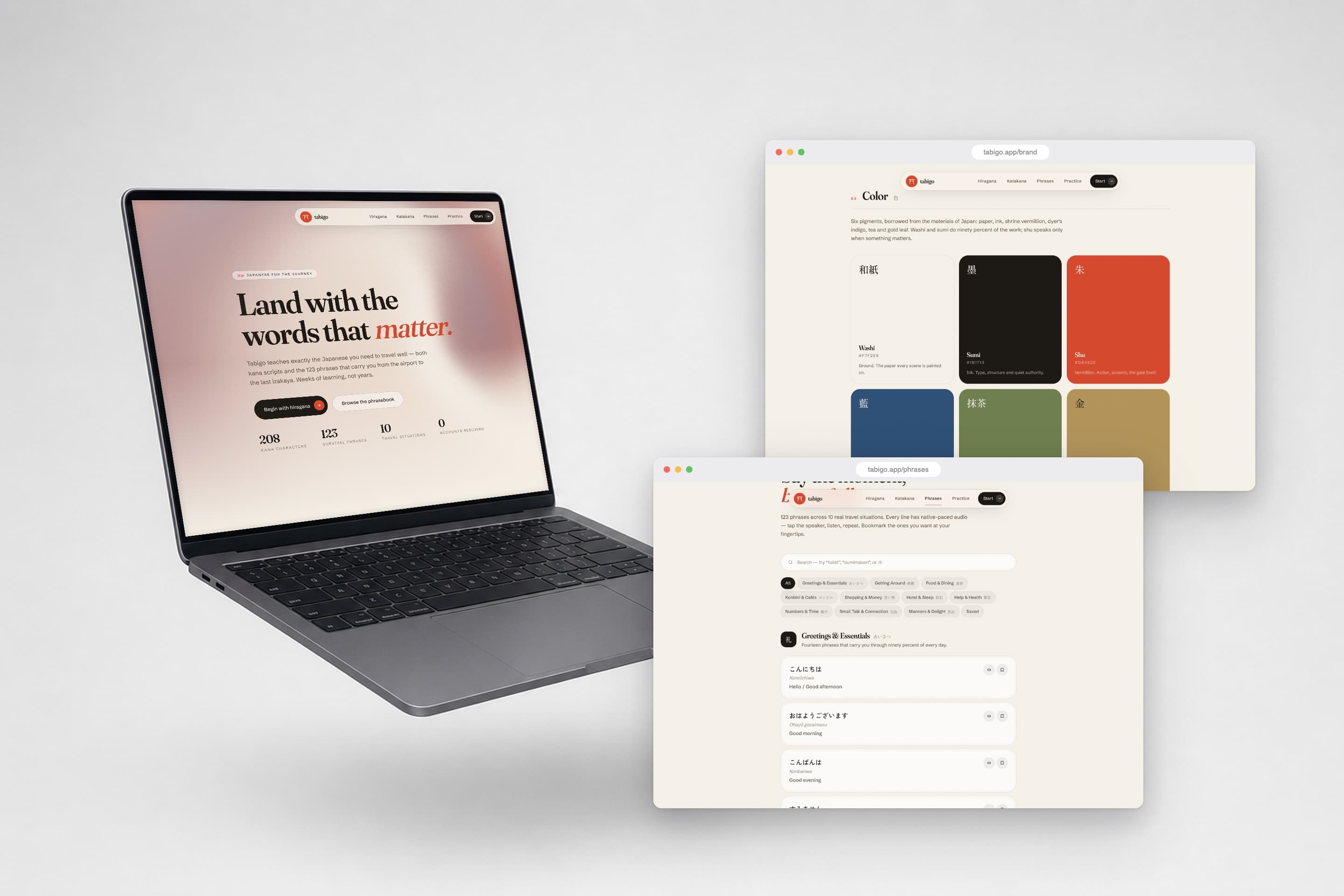
You have booked a trip to Japan and you have a few weeks before the flight. What you want is small and specific: to read a train platform, to order without pointing, to thank someone properly, to ask where the toilet is. What the app stores offer instead is a years-long fluency course with a streak to protect, a cartoon mascot and a guilt notification when you skip a day. Tabigo is the product that meets the actual need. It teaches exactly the Japanese that carries a traveller from the airport to the last izakaya, both kana scripts and 123 phrases, and it treats you, and Japan, like adults. I designed and built it solo over a weekend with Claude Code; everything you see here is the running app.

A travel brand that happens to teach language
The whole product turns on one decision: Tabigo is a travel brand that happens to teach language, not a language app that mentions travel. That reads like a slogan, but it set every choice that followed. A travel brand earns trust by being honest about scope, so Tabigo names its job plainly, survival Japanese for a specific trip, and refuses to promise fluency it could not deliver in a few weeks. A travel brand also feels like a place, so the surfaces are painted like one: warm washi paper, shrine vermillion, dyer's indigo, and live atmospheres rather than flat gradients.
Everything the category reaches for by reflex, Tabigo declines. There is no streak to break and no push notification to guilt you back. There is no account, because someone learning for one trip should not have to invent a login and surrender an email to do it. There is no cartoon Japan; the culture is held to the same care as the language. The voice follows from all of it: calm, precise, warm, never cute-ified. "Every miss is a rep, run it again," not "WRONG, try harder."
Read the signs
The first thing a traveller needs is not conversation, it is literacy: the moment menus, platforms and price tags stop being shapes and start being sounds. Tabigo teaches all 208 kana across both scripts, hiragana and katakana, in the order they are actually learned, the base gojuon grid first, then the voiced dakuten set, then the combination sounds. Tapping any character speaks it in Japanese through the browser's own speech engine, with no network call, and opens a card with a real travel word that uses it. Mastery is tracked per character, so the chart quietly fills in as you go.
Train what you miss
Recognition is not recall, so the charts and the phrasebook are backed by a practice studio. A session is ten rounds and about two minutes, the length of a train ride between two stops. It runs in both directions, kana to sound and sound to kana, and it is adaptive: the sampler weights each round toward the characters you have been getting wrong, so the drill spends its time where you are weak instead of where you are already fluent. A wrong answer is marked and moved past without ceremony. The point is reps, not punishment.
Speak the moment
The phrasebook is the heart of the trip. 123 phrases sit inside ten real situations, greetings, transit, dining, konbini, shopping, hotels, emergencies, numbers, small talk and manners. Each one carries the Japanese, the romaji, a native-paced audio reading, and a short cultural note so you know not only what to say but when it lands. You can search across all of them and bookmark the ones you need into your own pocket phrasebook, which is the view you actually open at the counter with a queue behind you.
Painted, never stock
Tabigo has a full brand book, gated behind a password because it belongs to the team, and it holds the identity to the same standard as the product. The palette is six pigments borrowed from the materials of Japan, washi paper, sumi ink, shu vermillion, indigo, matcha and gold, with washi and sumi doing ninety percent of the work and shu speaking only when something matters. The type pairs a Fraunces display voice with Schibsted Grotesk for the interface and two Japanese faces, a mincho serif for kana display and a gothic sans for running Japanese. The mark is a torii, the gate that stands at the threshold of a shrine, which is precisely what Tabigo is for a traveller's tongue.
The atmospheres are the part I am most attached to. Every ambient surface is painted live with WebGL shaders rather than shipped as video or stock imagery, and the same restraint governs them: a small set of named scenes is the entire vocabulary, they always run slow, and they freeze completely for anyone who prefers reduced motion. Backgrounds and ornaments are not drawn by hand either. They are grown in a generative studio of eight seeded, deterministic families, each locked to the six pigments and exportable at any size, so the brand can make its own assets forever without a stock library.
The claim only counts if the exports hold up outside the studio, so here are two of them at work. Both posts below are raw studio exports dressed with the brand's own type: a seigaiha wave field behind the phrase of the day, a noren stripe gradient behind the launch numbers. Nobody opened an art tool for either.
A product you are meant to finish
Tabigo keeps nothing. Your progress, which kana you have mastered and which phrases you saved, lives in your own browser, on your own device, and never reaches a server, because there is no server for it to reach. That is partly a privacy position, but it is mostly an honest one. The rest of the category is built to retain you: the streak, the notification, the endless tree, the account that quietly turns leaving into a chore. All of it optimises for the day you come back, because the business is counted in returns.
Tabigo optimises for the day you are done. It teaches a fraction, says so plainly, and hands you the fraction on your own device with nothing to sign and nothing to cancel. The honest version of a learning product is one you are meant to finish, one you outgrow the moment your plane lands and you order your first bowl of ramen without reaching for it. That was the point from the first commit, and building the whole thing this way, brand and product and shaders across a single weekend, is what kept the promise small enough to actually keep.
Next case study02
View all workTerraGrid