Digital Learning
Oil & Gas: Reimagine Learning Experience - reimagining staff and engineer training through a personalised digital learning journey.
- Client
- Malaysian Oil & Gas Company
- Role
- UX & UI design, research
- Year
- Sep 2018 to Jan 2019
- Discipline
- Experience Design
Learning and development remain crucial for many oil and gas companies to maintain and enhance the qualifications of their staff and engineers. However, the methods employed are often outdated, even by today's standards. In this project, we are exploring innovative ways to interact with technologies to fully realise a digital learning experience.
The Challenge
How might we digitise learning so that we create personalised experiences for learners?
The Goals
- Develop a digital learning journey that envisions a future-state learning experience, leveraging both current and emerging technologies.
- Enhance the learning process with a personalised digital platform, designed to make the entire journey both engaging and intuitive.
- Craft a seamless user experience that fluidly connects digital and physical touchpoints within the learning journey.
- Incorporate the digital learning experience with the existing Single Sign-On (SSO) feature for streamlined access and integration.
Solution: Design thinking workshop
We conducted a one-and-a-half-day design thinking workshop, inviting over 20 key users and stakeholders to brainstorm ideas, create an impact-effort matrix, identify current pain points, and outline both the as-is and to-be journeys.
By the end of the session, we had collected numerous insights and ideas, including three sets of as-is and to-be journeys, which were invaluable as we began crafting personas and the customer journey.
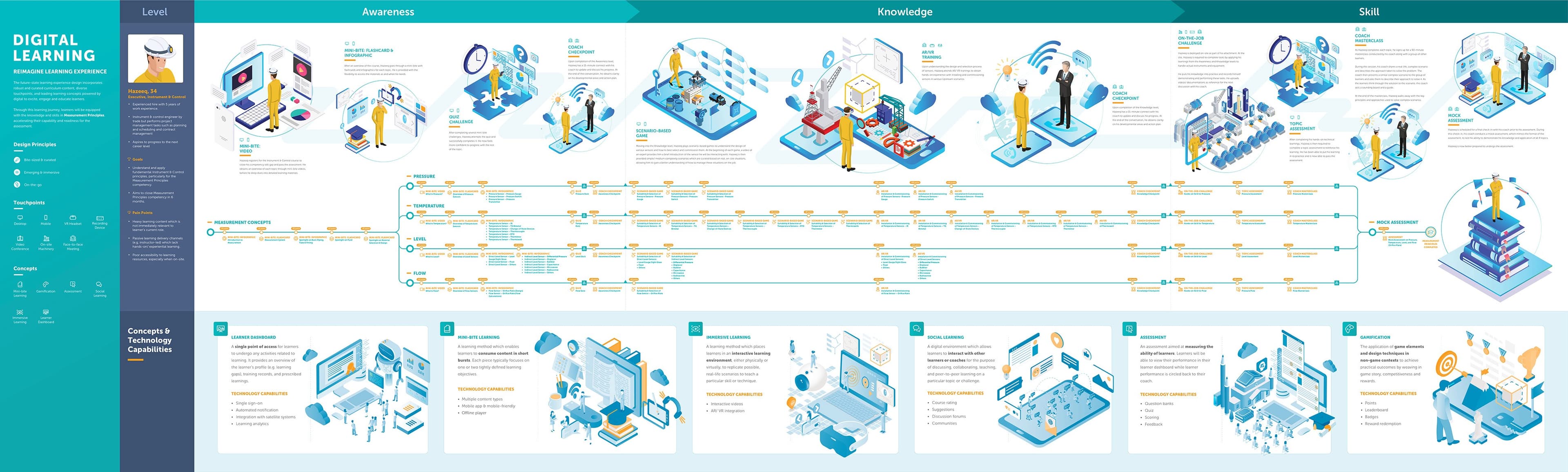
Solution: Craft the future-state journey
We identified two key personas and developed two distinct learning experience journeys based on them. Each journey has unique touchpoints, revealing various paths we hadn't considered prior to crafting these experiences. This approach guided our focus, enabling us to solve relevant issues and provide well-informed solutions.
Solution: Mobile app
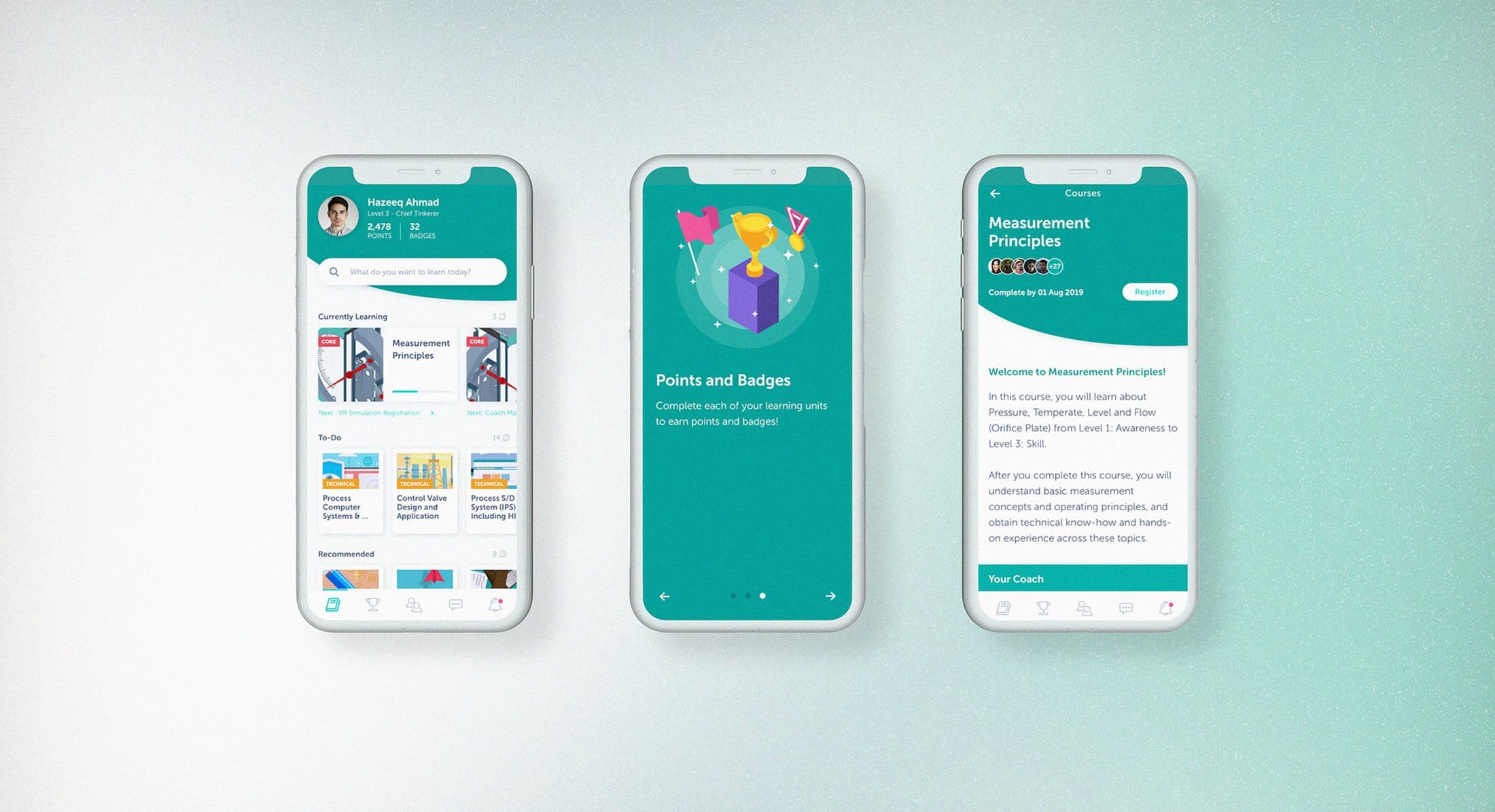
We developed a mobile app as the key touchpoint for completing the learning process, curating bite-sized modules so users can experience learning on the go. A personalised dashboard is tailored to each user's responsibilities, job scope, and skill gaps.
Solution: Create learning roadmap
We established a clear learning roadmap for the courses, with each module divided into digestible sizes so users do not feel overwhelmed. Registration is as simple as a click of a button, and each course is accompanied by a discussion platform and a resources centre.
Solution: Chat with Coach
To enhance engagement, we introduced the 'Chat with Coach' feature. The tool integrates with the learning content, sections, and resources, providing easy reference and a more interactive learning experience.
Solution: Insert gamification
We developed a curated, scenario-based game designed to simulate real-life situations, incorporating elements of fun gamification to create an engaging and educational experience.
Solution: Integrate virtual reality
We integrated Virtual Reality training into the learning journey to surpass the limitations posed by physical facilities and equipment. Tasks in the simulation are designed to closely mimic real training scenarios while capturing more accurate data and measurements, such as completion time, actions taken, and tools used. This approach offers a more comprehensive and realistic training experience.
Handover
After the final round of workshops, the design moved to the development team on schedule together with the learning-journey maps and the VR task specifications. What held the project together, in the end, was the reframing from the first workshop: treat training as a journey someone owns rather than a course someone attends. Once that was fixed, every later decision, the personalisation, the scenario games, the VR assessments, had a place to hang.
Next case study12
View all workDigital Finance